So, yesterday after the Wall Street close, two companies reported earnings that gave investors exactly what they wanted to hear.
Super Micro Computer and Advanced Micro Devices came out with numbers that sent their stocks soaring. What exactly happened? And why did the market react so positively?
SUPER MICRO
Let’s start with Super Micro Computer, better known as SMCI.
The company reported results for the third quarter of its fiscal year, which ended on March 31. And this is where things get interesting.
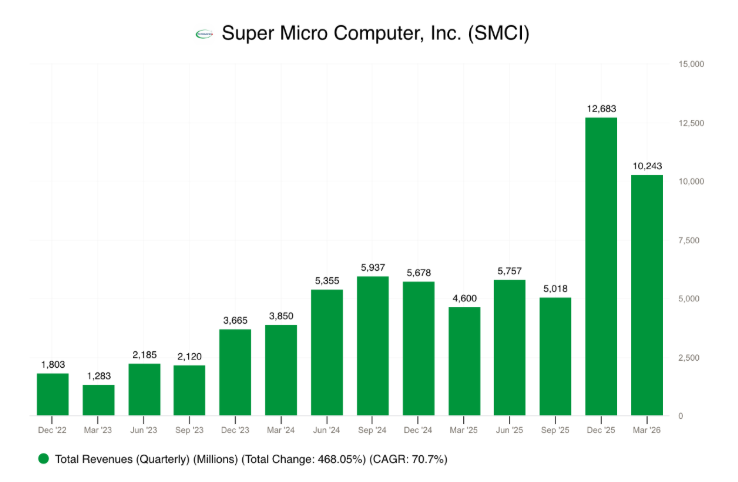
Revenue came in at $10.24 billion. Yes, you read that right. That represents 123% growth compared to last year. More than doubling revenue in just twelve months.
Even so, revenue still missed Wall Street expectations.
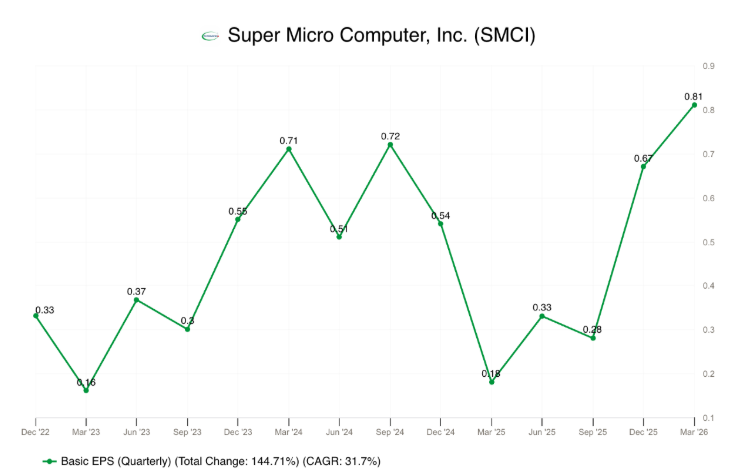
Earnings per share came in at 84 cents, while analysts were expecting 62 cents. In other words, the company earned almost 35% more than the market anticipated.
“But why did the stock jump 19% if revenue missed expectations?” you might ask.
Well, analysts were expecting $12.33 billion in revenue, while the company delivered $10.24 billion. So yes, technically it was a miss. But the market focused on something else. It focused on guidance, meaning what management expects going forward.
And the guidance was strong.
For the fourth quarter, SMCI expects revenue between $11 billion and $12.5 billion, with earnings per share between 65 and 69 cents. Both came in above Wall Street estimates.
So investors basically said:
“Alright, the quarter that just ended was a little weak, but the direction still looks strong.”
Of course, there is a major issue hanging over the company.
Earlier this year, a scandal emerged after U.S. prosecutors accused associates connected to the company of illegally exporting servers containing Nvidia chips to China. Among those implicated was a co founder and executive tied to the business.
CEO Charles Liang described the company as a victim in the case, while the executive involved has already stepped down.
Despite all that, the company keeps expanding.
It is building new production facilities in Silicon Valley, with total space expected to exceed 714,000 square feet. Liang also talked about “massive demand” across AI and enterprise markets. And judging by the numbers, he seems serious.
AMD
Now let’s move on to AMD.
Here, the numbers were arguably even stronger.
AMD reported first quarter 2026 revenue of $10.25 billion, up 38% year over year. Earnings per share came in at $1.37, while the market expected $1.29. Once again, better than expected.

But the most important piece was the Data Center business.
Revenue there reached $5.78 billion, representing 57% annual growth.
And CEO Lisa Su said something very important:
“Data Centers are now our primary driver of revenue and profitability.”

Why does that matter?
Because it shows AMD is no longer just a gaming graphics company. It is becoming a major player in AI infrastructure. And that is exactly what the market wants to see.
For the second quarter, AMD expects revenue around $11.2 billion. Wall Street was expecting $10.52 billion. Again, guidance came in ahead of estimates.
And as if that wasn’t enough, the company is preparing to launch Helios this year, its first rack scale system designed for AI data centers.
Both OpenAI and Meta have already placed orders.
That means AMD is beginning to seriously challenge Nvidia for large scale AI contracts.
The stock rose 5% in after hours trading, while already being up 60% over the last month and 250% over the last year. Incredible returns.
WHY BOTH COMPANIES DID SO WELL
So now you might ask:
“Was this just a coincidence?”
Not really.
There is one common factor behind both companies.
Artificial Intelligence.
More specifically, the massive global demand for AI infrastructure.
SMCI sells servers packed with Nvidia GPUs to companies building AI data centers. AMD sells AI accelerators and processors. Both companies sit right at the center of the global AI build out happening right now.
And they are not alone.
Micron Technology, the memory chip company, has surged more than 700% over the last year.
Intel just had one of the best months in its history.
The entire semiconductor industry is in a frenzy because demand for AI chips still shows no signs of slowing down.