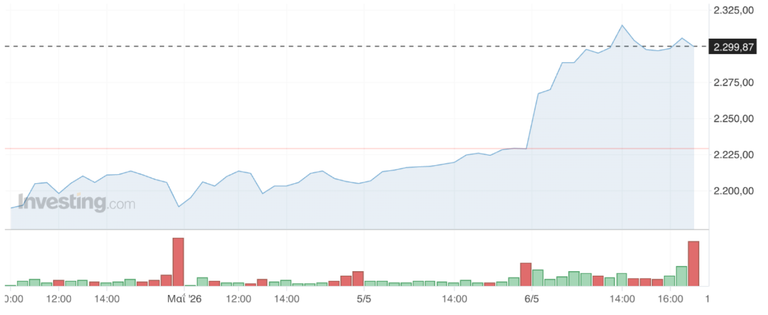
The Athens Stock Exchange erased all of its losses from the U.S.-Iran war in just three trading sessions.
At the same time, on the macroeconomic front, Greece is posting numbers we had not seen in many years. Debt lower than Italy’s. Early repayment of bailout-era loans. And a capital market that is maturing rapidly.
THE STOCK MARKET “ERASES” THE WAR
So yesterday, the General Index of the Athens Stock Exchange closed at 2,299 points. A gain of +3.17% in a single day. And if we look at the first three trading sessions of May combined? A TOTAL gain of +5.08%.
Yes, you read that correctly.
Turnover reached €438.78 million. The banking sector index surged +4.98%. And we saw record highs everywhere: Viohalco +10.9% at €17.3 with a new all-time high. GEK TERNA above €42 with a new all-time high. Cenergy at €25 with a new all-time high. And OTE at €18.6, levels not seen since the summer of 2008. An 18-year high.
“So what caused this rally?”
The answer comes from the Middle East. Trump suspended the military operation “Project Freedom” in the Strait of Hormuz. And Axios reported that the U.S. and Iran are close to a deal to end the war. No agreement has been signed. It simply appeared that one might happen. And that alone was enough to trigger a positive reaction across global markets, lifting Athens back to levels last seen before the war.
A CAPITAL MARKET THAT IS MATURING
Now let’s move to something that may not grab headlines but is equally important. The Greek capital market is maturing rapidly, and the numbers make that very clear.
In just the first months of 2026, around €430 million has been raised. €323 million through share capital increases and €105 million through private placements. CrediaBank led the way with a €300 million capital raise, while GEK TERNA acquired shares in EYDAP worth €103 million.
But that is not the biggest news. PPC announced a €4 billion capital increase. Four billion euros. One of the largest issuances in the history of the Greek market. And this is not just a corporate move, it is a vote of confidence in the ability of our market to finance major projects.
There is also another factor: the Euronext era. The CEO of Euronext spoke about daily trading volumes of €12-14 billion and a total listed market capitalization of €7 trillion. Greece joining this ecosystem means visibility to major international portfolios that until now viewed Greece as a “difficult” peripheral market.
THE TWO SCENARIOS FOR THE ECONOMY
Of course, not everything is perfect. And this is where things become even more interesting.
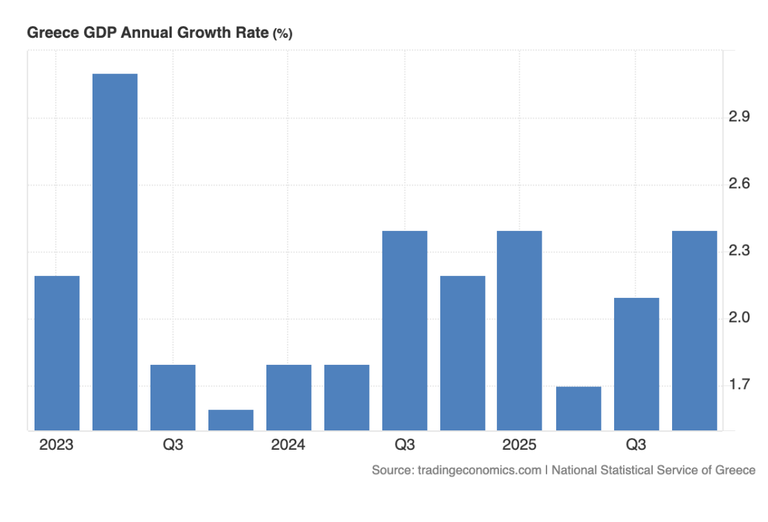
The official scenario for the Greek economy points to growth of around 2%, investments remaining on a positive path, and tourism continuing to act as a key driver of revenue inflows. Recovery Fund money keeps flowing. The labor market remains resilient. And all of this despite the war and the closure of the Strait of Hormuz.
Behind the scenes, however, the government’s economic team talks about “stability under conditions.” The core assumption is that energy pressures do not worsen. But what if they do?
So what is the bad scenario? It is energy costs, which first hit transportation, then industry, then commerce, and finally the consumer. Business profit margins shrink. Decisions for new investments are postponed. And consumption begins to show signs of fatigue. In such a scenario, growth would not collapse suddenly, but it would gradually slow down.
So the real “bet” for the economy is duration. The faster the geopolitical crisis ends, the faster we return to the “good scenario.”
THE DEBT THAT IS SHRINKING
And now the part that makes me feel optimistic about our country.
In mid-June, Greece is expected to proceed with the early repayment of €6.9 billion in bilateral bailout-era loans (GLF). Loans dating back to the memorandum years. And this move will save the Greek state around €90-100 million. At the same time, the country’s cash reserves reached €38.9 billion at the end of March. In other words, Greece now has a massive financial safety buffer.

But the most impressive part is this: according to the IMF’s latest forecasts, Greece’s public debt is expected to reach 136.9% of GDP by the end of 2026. Italy’s? 138.4%. Meaning that, for the first time, Greece will have lower debt than Italy. And according to the IMF’s previous report, this “passing of the baton” was expected to happen in 2029. It arrived earlier.
From there on, the projected path is clear: 130.3% in 2027, 125.2% in 2028, 120.4% in 2029. And below 100% of GDP by 2033-2034. The foundation of this decline is primary surpluses: 4.4% of GDP in 2025 and 3.8% in 2026, remaining at high levels despite their gradual moderation.
In simple terms? Greece is reducing its debt faster than even the IMF expected.