Yesterday was one of those days when the markets did not know where to look first.
On one hand, we had the Fed keeping interest rates unchanged. On the other, Powell himself came out and said that he will remain at the Fed as Governor. But to be honest, that was not the big news of the day.
Because the real show came after the market closed. Four of the Magnificent 7 reported quarterly results at exactly the same time: Microsoft, Amazon, Alphabet, and Meta. All together.
MICROSOFT
Microsoft kicked things off. And the truth is, the numbers were better than Wall Street expected.
Earnings per share came in at $4.27 versus the $4.06 analysts were expecting. Revenue came in at $82.89 billion versus $81.39 billion expected. That means revenue grew 18% compared to last year.
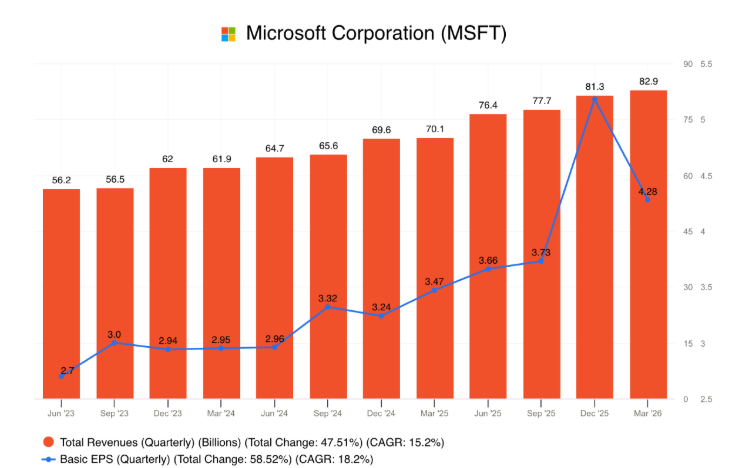
But the real star was Azure. Microsoft’s cloud revenue rose 40% in just one quarter. To understand how big that is, analysts were expecting around 39%. The entire Intelligent Cloud segment, which includes Azure, reached $34.68 billion.
And this is where the AI part comes in, which everyone wants to know about. Copilot now has more than 20 million business seats. In January, it had 15 million. So in just a few months, 5 million new users were added. Total annual AI revenue has now reached $37 billion, up 123%.
Despite all that, the stock fell after the news. Why? Because in the markets, good numbers are not always enough. The stock is already down 10% since the beginning of the year. And it is coming off its worst quarter since 2008.
There is also concern that the massive investments in AI may not deliver the returns the market wants. Even so, the quarterly numbers were truly impressive.
AMAZON
Now let’s move on to Amazon. Here, things get even more interesting.
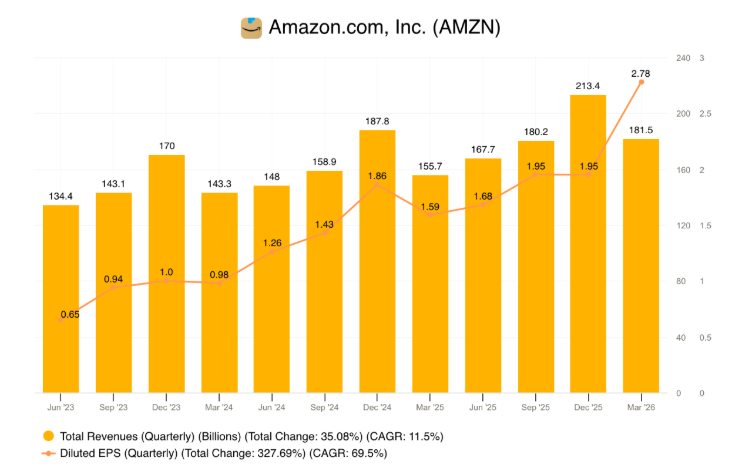
Earnings per share came in at $2.78 versus the $1.64 analysts were expecting. Almost double. Revenue came in at $181.52 billion, up 16.6% year over year.
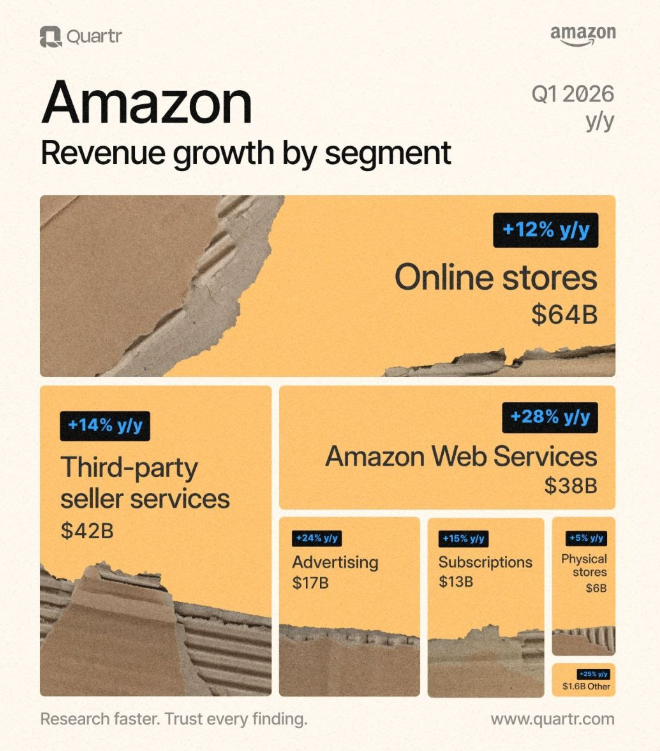
But the real show was stolen by AWS. Amazon’s cloud revenue rose 28% year over year and reached $37.59 billion. In fact, this was the fastest growth AWS has shown in more than three years.
And operating income? $23.9 billion. Above the company’s own guidance of $18 billion to $22.5 billion. Of that, $14.2 billion came from AWS alone. In other words, cloud does not only generate revenue. It also delivers massive profitability.
But there is another factor too. Free cash flow fell to just $1.2 billion over the last 12 months. Why? Because Amazon spent an additional $59.3 billion on equipment. And all of that extra spending is for AI.
CEO Andy Jassy himself said: “We are in the middle of one of the biggest growth transformations we will see in our lifetimes, and we are well positioned to lead.”
Now, for the next quarter, Amazon expects revenue of $194 billion to $199 billion. Well above analysts’ consensus.
ALPHABET
Now let’s go to Alphabet, where we probably saw the most impressive numbers of the night.
Revenue reached $109.9 billion versus the $107.2 billion analysts expected. That is 20% growth year over year. And pay attention to something very important: this is the highest growth rate the company has shown since 2022. Earnings per share came in at $5.11.
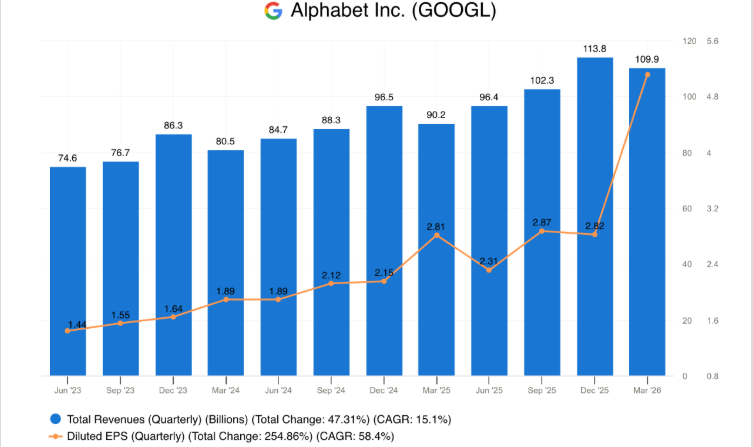
But the real wow effect came from Google Cloud. Up 63% year over year. Yes, you read that correctly. Sixty-three percent. Revenue reached $20.02 billion versus the $18.05 billion the market expected.
And this is where the most incredible number of the entire night comes in. Google Cloud’s backlog, meaning contracts that have been signed but not yet fulfilled, reached $460 billion. In other words, customers have already signed contracts for $460 billion worth of services that will be delivered in the future.

And that is not all. Paid monthly active users of Gemini Enterprise increased 40% in just one quarter. Google advertising revenue reached $77.25 billion, up 15%. And Waymo, the autonomous vehicle company, surpassed 500,000 fully autonomous rides per week.
META
And finally, we have Meta. Here, the story is a little more complicated.
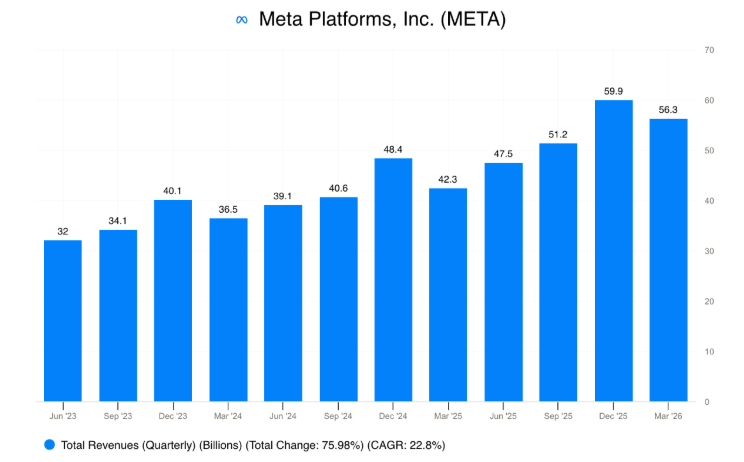
Revenue came in at $56.3 billion, up 33% year over year. Very strong numbers on their own. But the stock fell after the news. Why?
First, daily active people, known as DAP, reached 3.56 billion. Wall Street expected 3.62 billion. So that was a miss. Meta explained that there was a “slight quarter-over-quarter decline” due to internet outages in Iran and a ban on WhatsApp access in Russia.
Second, and perhaps more importantly, capex came in at $19.84 billion, well below estimates of $27.57 billion. But here comes the big news. Meta raised its full-year capex guidance from $115 billion to $135 billion, to $125 billion to $145 billion. In other words, it will spend even more. The explanation it gave was “higher equipment prices this year and additional data center costs to support future capacity.”
And as if that were not enough, Meta announced that it will lay off 10% of its workforce, around 8,000 people. On top of that, 6,000 open roles will be frozen. All of this is being done so the company can pour even more money into AI.
For the next quarter, Meta expects revenue of $58 billion to $61 billion, with the estimate falling within analysts’ forecast range, so there was nothing especially impressive there.