It’s been a while since I posted about the Middle East. Not because things calmed down, but because fundamentally, nothing had really changed. The war was still going on, the ceasefire was barely holding, and the Strait of Hormuz was still effectively closed.
But over the last few days, a lot has happened. And when I say a lot, I mean that within 72 hours we saw a military operation, a pause in that operation, a 14-point memorandum, threats of bombings, oil dropping 8% in a single day, and gasoline in the U.S. hitting $4.50 per gallon.
PROJECT FREEDOM
On Sunday night, Trump announced something called “Project Freedom.” In simple terms, it was a U.S. military operation designed to escort commercial ships out of the Strait of Hormuz.
And to understand the scale of this, we’re talking about 15,000 military personnel, more than 100 aircraft, guided missile destroyers, drones, basically everything. According to the Trump administration, around 23,000 sailors from 87 countries are trapped in the Persian Gulf because Iran shut down the strait.
Secretary of State Marco Rubio described them bluntly as “sitting ducks.” Isolated, vulnerable, running out of supplies. At least 10 sailors have reportedly already died.
So what happened next?
On Tuesday afternoon, barely 24 hours later, Trump announced that Project Freedom was being paused.
“There has been major progress toward a Full and Final Agreement with Iran,” he posted on Truth Social.
THE 14-POINT MEMORANDUM
And this is where things get even more interesting.
According to Axios, the White House believes it is close to finalizing a one-page, 14-point memorandum with Iran. The goal would be to end the war and establish a framework for broader nuclear negotiations.
What’s reportedly included?
Iran would agree to a moratorium on uranium enrichment, the U.S. would lift sanctions, and both sides would stop interfering with shipping traffic in Hormuz. In other words, the strait would reopen to everyone, including Iran itself.
The U.S. is reportedly expecting a response from Tehran within the next 48 hours through Pakistan, which is acting as an intermediary.
And here’s the important part. According to sources, this is the closest the two sides have come to a deal since the war began on February 28.
But on Wednesday, Trump added his usual twist.
“If they don’t agree, the bombings will begin, and they will be at a much higher level and intensity than before,” he wrote.
Yes, really.
On one hand he says a deal is close. On the other, he threatens even larger airstrikes. Classic Trump.
Iran’s Foreign Ministry spokesperson responded by saying that “negotiation” means a good faith effort to resolve differences, not “dictation,” “deception,” or “blackmail.”
HOW THE MARKETS REACTED
Now let’s get to the part that affects everyone. The markets.
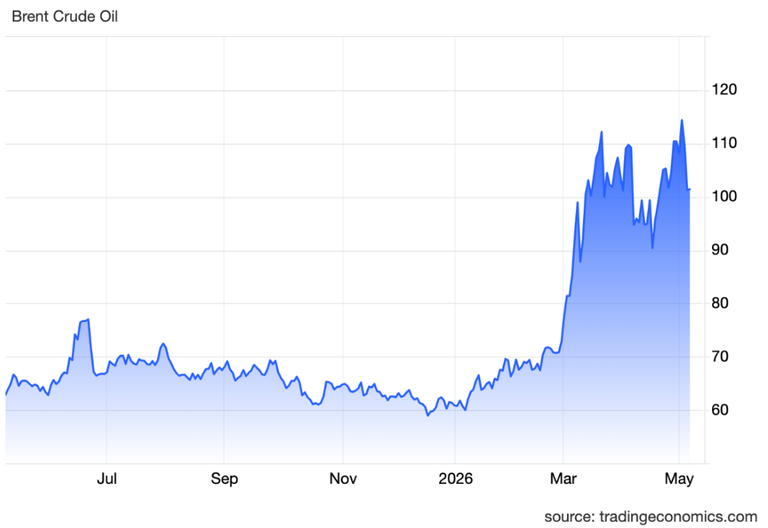
On Wednesday, after reports about the memorandum surfaced, Brent crude fell nearly 8% in a single day, while U.S. WTI crude dropped around 7%.
But yesterday, as doubts emerged about whether the agreement would actually happen, stocks pulled back and oil prices climbed again.
At this point, literally every Trump post is moving billions of dollars.
And then there’s the most painful number of all.
Gasoline prices in the U.S. rose above $4.50 per gallon for the first time since July 2022, according to AAA. The average American now feels this every single time they fill up their car.
Warren Patterson from ING put it clearly: “Any agreement that normalizes oil flows through Hormuz is critical.”
Why?
Because around 13 million barrels per day of disrupted supply are currently being offset largely by inventories. And those inventories are shrinking fast. Every day this continues, the market becomes more vulnerable.
And even if Hormuz reopened tomorrow, Nicolo Bocchin from Azimut warned that it would still take “weeks and weeks” for trade flows to normalize.
LEBANON, CHINA, AND DOMESTIC PRESSURE
At the same time, the situation is not purely diplomatic.
Israel announced that it killed a Hezbollah commander in the southern suburbs of Beirut, marking the first strike on the city since last month’s ceasefire. In other words, the Lebanon ceasefire is also hanging by a thread.
Meanwhile, Iran’s Foreign Minister met with Chinese Foreign Minister Wang Yi in Beijing. China, one of the biggest buyers of Iranian oil, reportedly told Tehran that continuing the conflict would be “unwise.”
And this is where Saudi Arabia and Kuwait enter the picture. According to The Wall Street Journal, both countries have opened their bases to U.S. forces. Meaning that if negotiations collapse, Trump already has a Plan B.
But there’s also domestic pressure building in the United States.
Midterm elections are only six months away, and polls suggest Americans are growing tired of the war. With gasoline at $4.50 and energy costs eating into household budgets, the political pressure is becoming intense.
