Today I want to talk about an economic data point that… quite honestly, nobody expected.
Because on Friday, the latest data on the labor market in the United States was released, and the surprise was huge.
Analysts were expecting the economy to add around 60,000 new jobs. Instead, the American economy actually lost 92,000 jobs in a single month.
Yes. Minus 92 thousand.
And that was enough to shake markets, analysts, and of course the Federal Reserve. Suddenly, the largest economy in the world is sending a very strange signal.
On one side, inflation is still above the Fed’s target. On the other hand, the labor market is starting to show signs of weakness. And this contradiction is exactly what makes things extremely difficult for the Fed right now.
The Labor Market
According to the Bureau of Labor Statistics, the so called nonfarm payrolls, which measure jobs outside the agricultural sector, fell by 92,000 in February.
So while the market was expecting an increase, what we actually saw was a sharp drop.
In fact, this is the third decline in jobs in the last five months.
At the same time, the unemployment rate rose to 4.4 percent from 4.3 percent.

That might sound like a small change, but in the markets, movements like this are watched very closely.

So where did all these jobs disappear?
The truth is that several major sectors saw declines.
For example, the healthcare sector lost around 28,000 jobs, partly because of a large strike in hospitals.
The technology sector lost about 11,000 jobs, something many people link to cuts related to artificial intelligence.
Manufacturing lost roughly 12,000 jobs, the federal government lost another 10,000, and even sectors like transportation, warehousing, and construction saw job losses.
In other words, the decline is not limited to just one sector.
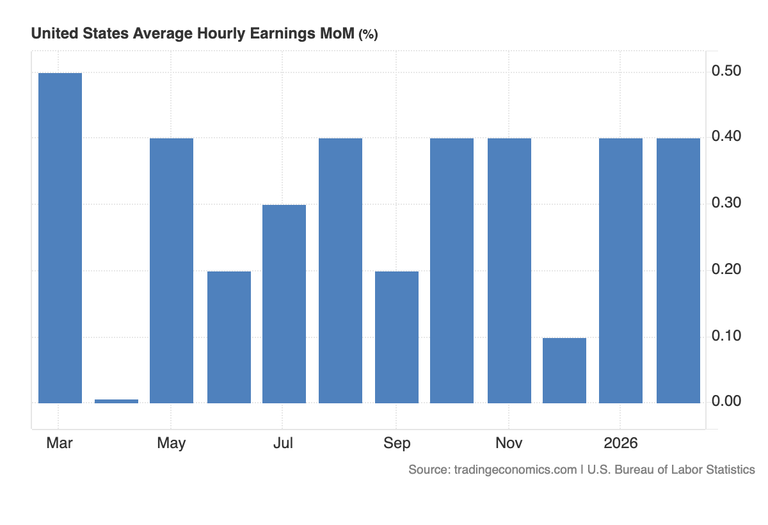
At the same time though, there is a strange paradox. While the labor market appears to be weakening, wages continue to rise.
Average hourly earnings increased by 0.4 percent during the month and about 3.8 percent on an annual basis.
And as if all that were not enough, there is another factor to consider.
Energy prices.
With the war in the Middle East pushing oil prices higher, Brent crude has reached around 90 dollars per barrel.
And that is once again adding pressure to inflation.
The Fed’s Dilemma
All of this data, combined with the war in the Middle East that is pushing oil prices close to 90 dollars per barrel, is increasing inflationary pressures.
And this is exactly why the Federal Reserve finds itself in a very difficult position once again.
The Fed has two main goals: keep inflation low and maintain a strong labor market.
But right now, those two goals are colliding.
That is why there is now a huge debate about what the Fed should do next.
According to the FedWatch Tool, markets right now are roughly fifty fifty on what the Fed will do in July. There is almost an equal probability that interest rates will stay where they are, or that a new cycle of rate cuts could begin.
The Different Views
As expected, analysts and officials have already split into different camps.
Fed governor Stephen Miran believes monetary policy is already too restrictive. In fact, he said something quite interesting. He argued that the Fed is chasing what he called “phantom inflation”.
In other words, inflation that may not actually be as strong as policymakers think.
He also argues that the weak labor market, especially among young workers and recent graduates, suggests the problem is not the supply of workers but the demand from businesses.
Simply put, companies are not hiring enough. And according to Miran, that means interest rates are too high.
On the other hand, there are also more cautious voices.
For example, Mary Daly, president of the San Francisco Fed, said that the labor market report is certainly concerning. At the same time, she warned that it is dangerous to draw conclusions from just one month of data.
The labor market often shows a lot of volatility, so the Fed needs to see more data before making major decisions.
At the same time, David Kelly from JPMorgan has a more pessimistic view.
According to him, if you look at the data from the past few months, the labor market has essentially frozen. Some companies are hiring, others are laying people off, and in the end the overall result is almost zero.
Finally, the research firm TS Lombard argues that the strong job growth we saw in January was probably a false alarm. A statistical effect that made the market believe the economy was accelerating. But according to them, the real picture of the labor market is that it remains stuck.