Eighteen months ago, Intel had lost 60% of its value in a single year. Its CEO, Pat Gelsinger, had been pushed out. Everyone was talking about a company that had “missed the AI train.” Everyone had written it off.
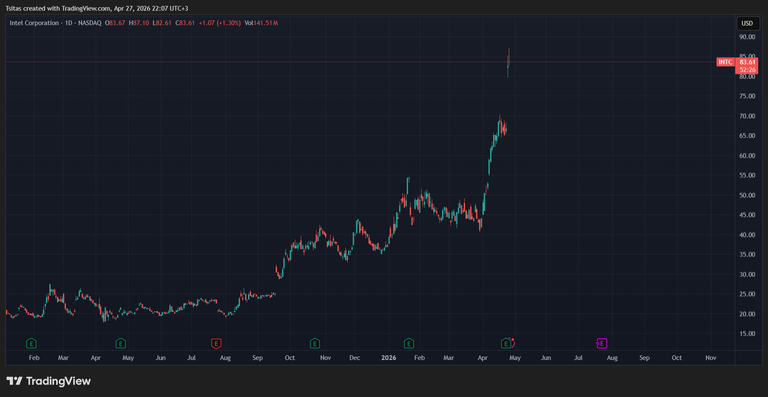
And on Friday? Intel’s stock surged 24% in a single day. Its best day since October 1987. Yes, you read that correctly. Since 1987.
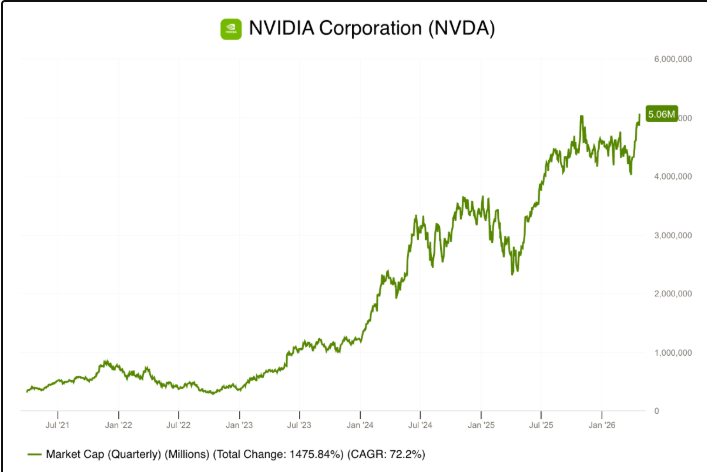
And it did not rise alone. It pulled AMD, Nvidia, Qualcomm, and ARM along with it. The entire chip sector caught fire. Nvidia closed at a record high and once again surpassed a market capitalization of $5 trillion.
The rally no one expected
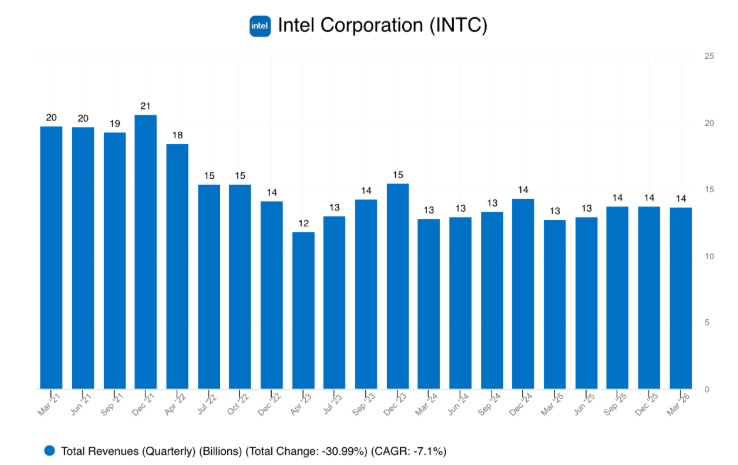
Intel announced its first-quarter results and absolutely crushed expectations. Revenue rose 7.2% to $13.58 billion, up from $12.67 billion a year earlier. And pay attention to this: over the previous seven quarters, Intel had posted five year-over-year revenue declines.
Then suddenly, its data center business jumped 22% year over year to $5.1 billion. Guidance for the second quarter also came in above analysts’ expectations.
The stock closed at $82.57. To understand how big this is, Intel is now up 124% year to date, after gaining 84% throughout all of 2025.
Wall Street analysts rushed to upgrade the stock. Evercore ISI, Citi, and Roth Capital all raised their ratings to Buy. “The new CEO fixed the balance sheet and put Intel back on a competitive path,” Evercore analysts wrote.
The new CEO, Lip-Bu Tan, took over in early 2025. And within just a few months, he managed to secure a $5 billion investment from Nvidia, close a deal with Google for Xeon chips in its data centers, enter Elon Musk’s Terafab project, and convince Tesla to use 14A technology. All of this came on top of the $8.9 billion stake the U.S. government took in the company.
The whole sector caught fire
And this is where things get even more interesting.
It was not just Intel that rose. AMD jumped 12% to 14% without any news of its own. No earnings, no announcements, nothing. It simply rose because Intel showed that CPU demand is real.
“We understood that CPUs were the next major bottleneck, but Intel’s results show that this is already translating into massive upside,” wrote an analyst at D.A. Davidson. The firm upgraded AMD to Buy and raised its price target to $375.
Nvidia, on the other hand, closed at a record high for the first time since October. It ended the day at $208.27, up 4.3%. Its market capitalization once again exceeded $5 trillion. Since the end of 2022, Nvidia’s stock has risen almost fourteenfold. Fourteen times higher.
And as if that were not enough, Qualcomm rose 11% and ARM gained 10%.
So what does this mean? It means the entire semiconductor sector caught fire within a few hours because of a single earnings report. But it also seems that the semiconductor rally had started earlier. Just look at the iShares MSCI Global Semiconductors ETF, which has risen nearly 29% in just one month.
The new AI bottleneck
And now comes the most important part. Why did all of this happen?
Until now, when people talked about AI, they talked about GPUs. Nvidia, Nvidia, Nvidia. Everyone was focused on graphics cards. CPUs had been pushed to the sidelines, almost treated like old technology.
But something is changing. With the arrival of AI agents, meaning AI systems that can perform tasks on their own, the so-called agentic workloads, CPUs are coming back into focus. And they are doing so with such force that analysts are now talking about a CPU shortage.
“CPUs are once again emerging as the essential foundation of the AI era,” Intel’s CEO said. And the numbers support him.
Intel now expects double-digit server CPU unit growth for 2026. Six months ago, it was talking about minimal growth. Wedbush analysts said something even more striking: demand for compute was “underserved by a number ending in B.” In other words, by billions.
You may now be wondering: how long will this shortage last? Morgan Stanley’s answer is: probably for quite some time. And that benefits all CPU manufacturers: Intel, AMD, ARM, everyone.
In other words, the story is changing. It is no longer “GPUs versus everything else.” It is “GPUs and CPUs together.” And that completely changes the investment landscape for the semiconductor sector.