
~~~ La versione in italiano inizia subito dopo la versione in inglese ~~~
ENGLISH

02-01-2026-Technologies and Production Systems-Friction and Lubrication [EN]-[IT]
With this post, I would like to provide a brief introduction to the topic mentioned above.
(lesson/article code: EX_LS_24)

Image created with artificial intelligence, the software used is Microsoft Copilot
Introduction to Friction and Lubrication
Friction is the physical phenomenon that opposes relative motion.
The mathematical formula for friction is shown below.

where:
𝐹𝑎 = friction force
μ = coefficient of friction
N = normal contact force
Lubrication is the set of techniques that reduce friction.
Lubrication can:
- reduce friction between two contacting surfaces
- promote material flow
- make deformation more uniform and controlled.
Friction during machining
During plastic machining, material deformation occurs through direct contact between the workpiece and the tool. Friction is therefore inevitable.
When contact occurs, friction is generated because the force applied by the machine induces a normal stress on the contact surface. Furthermore, it also induces a relative motion of the material with respect to the tool, which is opposed by a tangential stress.
Important: from an energy perspective, friction is a dissipative phenomenon. It transforms mechanical energy into heat, causes tool wear, and reduces its useful life.
We can say that in certain situations, friction can be seen as a negative phenomenon because it increases loads, increases processing energy, accelerates wear, and impairs material flow control. If, however, we were to consider a braking system, friction in this case is certainly not a negative phenomenon.
Coulomb's Law

Image created with artificial intelligence, the software used is Microsoft Copilot
Coulomb's law expresses the frictional force (or tension) as proportional to the normal force and mathematically presents itself as follows:

where:
T = tangential friction force
N = normal force
μ = coefficient of friction
p = contact pressure
When friction is zero, that is, μ = 0, we are in the ideal case.
Below are some examples of friction coefficients.
For steel on steel (dry), static friction is 0.74, and dynamic friction is 0.57.
When the pair becomes Teflon on Teflon, static friction drops to 0.04, while dynamic friction also drops to 0.04.
When the pair becomes Steel on Ice, friction drops even further. Static friction becomes 0.027, while dynamic friction even drops to 0.014.
Another way to understand the importance of friction is by studying the rubber-on-concrete pair.
If we consider rubber on dry concrete, we have μs = 0.65 and μₖ = 0.5.
If we consider rubber on wet concrete, we have μs = 0.40 and μₖ = 0.35.
Note: μs = static friction and μₖ = dynamic friction.
Tangential force as a function of normal force N in the real case
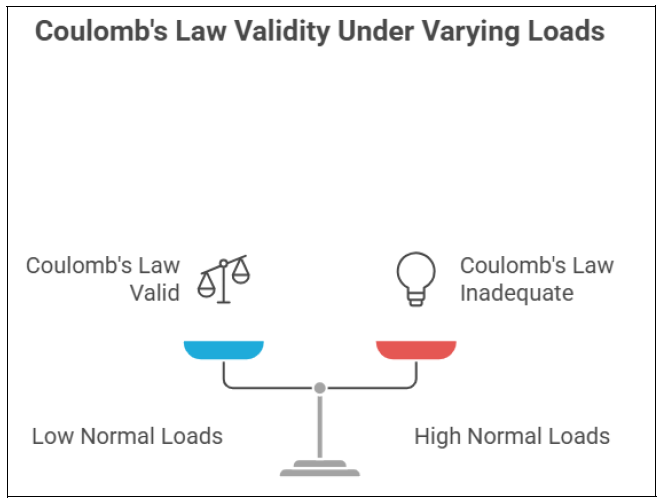
Image created with artificial intelligence; the software used is Napkin.ai
In industrial reality, surfaces are not smooth, but have rough edges. Actual contact occurs only on the crests of the contact surface.
There are two main cases:
- Low normal loads, in which case Coulomb's law is valid.
- High normal loads, in which case Coulomb's law is no longer adequate.
To clarify the concept, we can say that actual behavior is different because the surfaces are not smooth, but have crests and valleys. Therefore, actual contact occurs only on the asperities, so the actual contact area Ar is much smaller than the apparent area A.
Conclusions
We can conclude that friction in plastic machining arises from contact and relative motion between the workpiece and the tool and is a dissipative phenomenon that accelerates wear and reduces tool life. Coulomb's law describes friction through the coefficient μ and is applied to the study of friction between two rigid bodies, in fastening systems, and in structural contacts.
Historical Notes and Questions
In the field of friction studies, we can cite the French physicist Guillaume Amontons (1663–1705).
Did you know that Amontons formalized the laws of dry friction and showed that friction between surfaces is proportional to the normal force?
The French physicist Charles-Augustin de Coulomb (1736–1806) completed and generalized Amontons' approach.
Did you know that it was Coulomb who distinguished friction into static and dynamic friction?

ITALIAN

02-01-2026-Tecnologie e sistemi produttivi-Attrito e lubrificazione [EN]-[IT]
Con questo post vorrei dare una breve istruzione a riguardo dell’argomento citato in oggetto
(codice lezione/articolo: EX_LS_24)
immagine creata con l’intelligenza artificiale, il software usato è Microsoft Copilot
Introduzione all’attrito e lubrificazione
L’attrito è quel fenomeno fisico che si oppone al moto relativo.
Qui di seguito è mostrata la formula matematica dell’attrito.
dove:
𝐹𝑎 = forza di attrito
μ = coefficiente di attrito
N = forza normale di contatto
La lubrificazione è l’insieme delle tecniche che consentono di ridurre l’attrito.
Con la lubrificazione si può:
-ridurre l’attrito tra due superfici a contatto
-favorire lo scorrimento del materiale
-rendere la deformazione più uniforme e controllata.
L’attrito durante una lavorazione
Durante una lavorazione plastica, la deformazione del materiale avviene per contatto diretto tra pezzo e utensile. L’attrito è quindi inevitabile.
Quando avviene il contatto l’attrito si genera perché la forza applicata dalla macchina induce una tensione normale sulla superficie di contatto. Inoltre si induce anche un moto relativo del materiale rispetto all’utensile, al quale si oppone una tensione tangenziale.
Importante: dal punto di vista energetico, l’attrito è un fenomeno dissipativo. Esso trasforma energia meccanica in calore, provoca usura dell’utensile e riduce la vita utile dell’utensile.
Possiamo dire che l’attrito in certe situazioni può essere visto come un fenomeno negativo perché aumenta i carichi, aumenta l’energia di lavorazione, accelera l’usura e peggiora il controllo del flusso del materiale. Se invece dovessimo pensare ad un sistema di frenatura, l’attrito in questo caso non è certamente un fenomeno negativo.
La legge di Coulomb
immagine creata con l’intelligenza artificiale, il software usato è Microsoft Copilot
La legge di Coulomb esprime la forza (o tensione) di attrito come proporzionale alla forza normale e matematicamente si presenta come segue:
dove:
T = forza tangenziale di attrito
N = forza normale
μ = coefficiente di attrito
p = pressione di contatto
Quando l’attrito è nullo, cioè μ=0, siamo nel caso ideale.
Qui di seguito alcuni esempi di coefficienti d’attrito.
Abbiamo che Acciaio su Acciaio (asciutto) l’attrito statico è do 0,74, l’attrito dinamico è di 0,57.
Quando la coppia diventa Teflon su Teflon, l’attrito statico si abbassa e diventa 0,04, anche quello dinamico vale 0,04
Quando la coppia è Acciaio su Ghiaccio, l’attrito si abbassa ulteriormente. L’attrito statico diventa 0,027, mentre quello dinamico addirittura diventa 0,014.
Un’altra cosa che possiamo capire quanto è importante l’attrito è lo studio della coppia gomma su cemento.
Se prendiamo in esame gomma su cemento asciutto abbiamo μs = 0,65 e μₖ = 0,5
Se prendiamo in esame gomma su cemento bagnato abbiamo μs = 0,40 e μₖ = 0,35
Note: μs = attrito statico e μₖ attrito dinamico
La forza tangenziale in funzione della forza normale N nel caso reale
immagine creata con l’intelligenza artificiale, il software usato è Napkin.ai
Nella realtà industriale, le superfici non sono lisce, ma presentano asperità. Il contatto reale avviene solo sulle creste presenti sulla superficie di contatto.
Si distinguono due casi principali:
-Carichi normali bassi ed in questo campo la legge di Coulomb è valida.
-Carichi normali elevati, in questo caso la legge di Coulomb non è più adeguata
Per chiarire il concetto possiamo dire che il comportamento reale è diverso perché Le superfici non sono lisce, ma presentano creste e valli. Quindi Il contatto reale avviene solo sulle asperità, quindi l’area reale di contatto Ar è molto più piccola dell’area apparente A.
Conclusioni
Possiamo concludere dicendo che l’attrito nelle lavorazioni plastiche nasce dal contatto e dal moto relativo tra pezzo e utensile ed è un fenomeno dissipativo che accelera l’usura e riduce la vita utile dell’utensile. La legge di Coulomb descrive l’attrito tramite il coefficiente μ e viene applicata nello studio d’attrito tra due corpi rigidi, nei sistemi di fissaggio e nei contatti strutturali.
Cenni storici e domande
Nell'ambito dello studio degli attriti possiamo citare il fisico francese Guillaume Amontons (1663–1705).
Sapevate che Amontons formalizzò le leggi dell’attrito secco e mostrò che l’attrito tra superfici è proporzionale alla forza normale?
Il fisico francese Charles-Augustin de Coulomb (1736–1806) completò e generalizzò l’approccio di Amontons.
Sapevate che fu Coulomb a distinguere l’attrito in attrito statico e attrito dinamico?
THE END