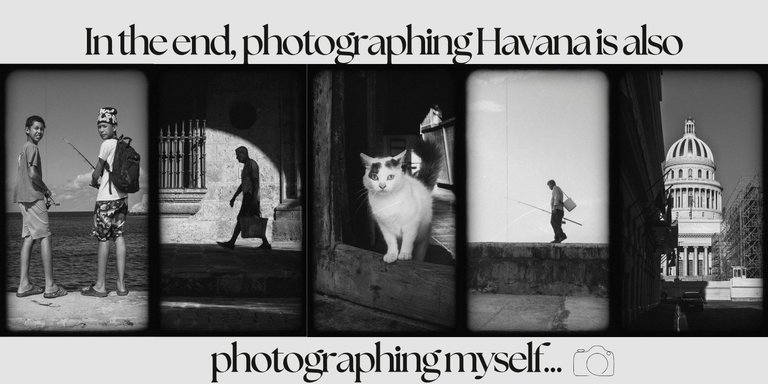
These snapshots 📸 are my submission for the #monomad challenge by @monochromes and @brumest.
Greetings, friends of #blackandwhite
When you walk around Havana, the first thing that usually catches your eye is the architecture. And I don't mean the styles exactly, but something more human: the way we Cubans have learned to share spaces that were once intended for very few.

Let me explain further. Many of the buildings we see today—which once belonged to very wealthy individuals—were occupied by several families after the changes that took place in 1959. Over time, without the necessary resources for maintenance, they lost some of their splendor and were transformed into multi-family buildings, with all the deterioration that this entails.

There are areas where this is particularly evident: houses that resemble palaces turned into inhabited ruins.

As a street photographer, I can't deny that it's visually striking. The contrasts, the textures, the stories those walls tell... it's all very powerful. But I'm always overcome by a certain sadness when I think about the abandonment and how we've had to adapt.

Housing is a complex issue almost everywhere in the world, but in Cuba the contrasts are stark. Different styles, different eras, and different realities coexist in the same space. It's difficult to explain unless you walk around and see it for yourself.


And so we carry on, living and adapting.
For my part, I continue to walk the streets of the city, sharing what I find at every turn.
Take good care of yourselves.
I'll read your comments.
See you soon.
Spanish Version - Click here
Mis saludos, amigos de #blackandwhite
Cuando uno camina por La Habana, lo primero que suele llamar la atención es la arquitectura. Y no me refiero exactamente a los estilos, sino a algo más humano: la manera en que los cubanos hemos aprendido a compartir espacios que alguna vez fueron pensados para muy pocos.
Me explico mejor. Muchas de esas edificaciones que hoy vemos —y que en su momento pertenecieron a personas muy adineradas—, después de los cambios ocurridos a partir de 1959, pasaron a ser habitadas por varias familias. Con el tiempo, y sin los recursos necesarios para su mantenimiento, perdieron parte de su esplendor y se transformaron en edificios multifamiliares, con todo el deterioro que eso implica.
Hay zonas donde esto es especialmente evidente: casas que parecen palacios convertidas en ruinas habitadas.
Como fotógrafo callejero, no puedo negar que visualmente es impactante. Los contrastes, las texturas, las historias que cuentan esas paredes… todo es potente. Pero siempre me acompaña una cierta tristeza al pensar en el abandono y en cómo hemos tenido que adaptarnos.
La vivienda es un tema complejo en casi todo el mundo, pero en Cuba los contrastes son brutales. Diferentes estilos, distintas épocas y realidades coexistiendo en un mismo espacio. Es algo difícil de explicar si no se camina.
Y así seguimos, viviendo y adaptándonos.
Por mi parte, continúo recorriendo las calles de la ciudad, compartiendo lo que voy encontrando a cada paso.
Cuídense mucho.
Los leo en los comentarios.
Nos vemos pronto.
Technical data:
📸 Nikon D200, AF-S NIKKOR lens 70-300 mm 1:4.5-5.6 G ED
📝 Translation: DeepL (free version)
🙋♂️ Authorship: All photos were taken by me @muhammadhalim.
Redes y contacto
📸 Instagram: @muhammad_photography
📘 Facebook: Muhammad Halim Machado
💬 WhatsApp: Escríbeme por WhatsApp