English version
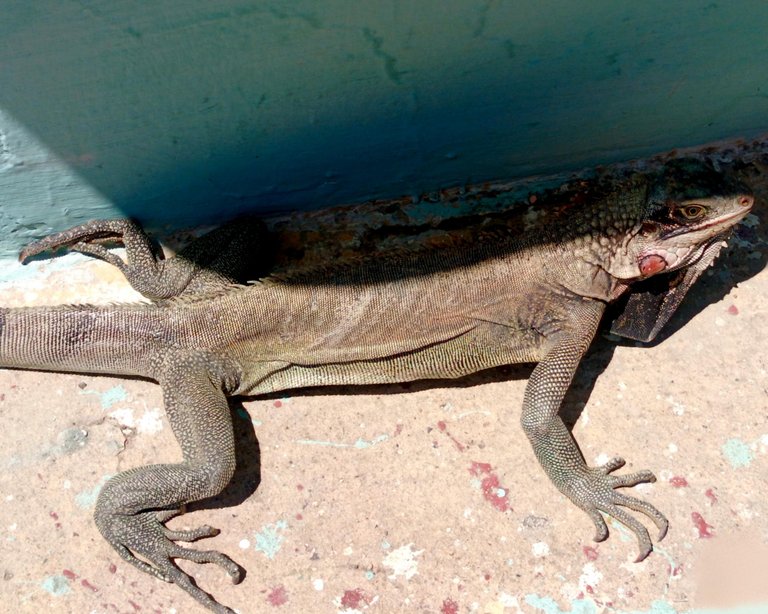
While walking through the historic district of Cumaná, from the Basilica of Santa Inés to Plaza Badaracco Bermúdez, I came across a rare sight in this area: a green iguana about 60 centimeters long and weighing around 15 kilograms. It seemed disoriented and was fleeing in fear from the people passing by at that hour.

This specimen had a small dorsal crest; based on its features, it appears to be a young female, as it has a barely noticeable dewlap and, as can be seen in the photos, does not appear wrinkled—characteristics typical of males. Iguanas are usually green, which allows them to blend in among the leaves on trees, but I have also seen them in shades of ochre, yellow, and orange.

I stopped to take a picture of this reptile. I’ve come across iguanas on the streets and even at home on several occasions. When I had a guava tree in my backyard, a pair of iguanas showed up and decided to stay; you could hear them slithering across the roof, which was annoying when I was trying to rest.
One of the iguana’s unique traits is that, as a cold-blooded animal, it regulates its body temperature by basking in the sun; this is why they turn brown. They do this to shake off lethargy and become active so they can move quickly and survive.They are generally herbivores, feeding on flowers, leaves, and fruits, but if an unsuspecting insect is around, they’ll eat it. They’re also excellent climbers; I’ve seen them in action, scaling tall trees with skill. They’re harmless to humans, but you shouldn’t get too complacent because some may bite or use their tails like whips when they feel threatened.
As reptiles, like lizards, they have the ability to shed their tails, which can later regrow, allowing them to escape predators such as birds of prey, dogs, cats, and rats. This defense mechanism serves both to create confusion and to speed up their escape.

As seen in the photographs, iguanas have bodies covered in scales and very short legs with five claw-like toes, which allow them to cling to tree trunks and branches, although to tell the truth, I’ve seen quite a few iguanas fall from trees and remain disoriented for quite some time.
Like humans, iguanas are diurnal, meaning they are active during daylight hours and sleep at night. They are oviparous; after a gestation period of about two months, the females lay their eggs underground and then leave. The hatchlings emerge after four months and must fend for themselves, which complicates their survival.

Another interesting characteristic is that they are excellent swimmers, allowing them to live near rivers or lagoons, such as those in Guaiquerí Park, near the banks of the Manzanares River, where large specimens can be observed.
One of the dangers iguanas face is indiscriminate hunting; their meat is highly prized and considered an exotic delicacy, as are their eggs, and they are even referred to as the “chicken of the trees” due to the similarity of their meat. In this regard, it is important to note that the only edible iguana is the green, herbivorous species, and that it must be thoroughly cooked; any other iguana can pose a risk if consumed without knowing its origin, as it may harbor highly aggressive bacteria in its body.

In the case of this iguana that appeared in the Historic District, it was returned to its area of origin, as it had come from the inner garden of the Casa Ramos Sucre.
Versión en Español
Caminando por el Casco Histórico de la ciudad de Cumaná, desde la Basílica de Santa Inés hasta la Plaza Badaracco Bermúdez, me topé con una visitante poco común en esta zona, una iguana verde de unos 60 cms de largo y unos 15 kg que lucía desorientada, huía asustada de las personas que transitaban por el lugar a esa hora.
Este ejemplar tenía la cresta dorsal pequeña, por sus rasgos parece una hembra joven ya que posee una papada poco pronunciada y, como se advierte en las imágenes, no luce arrugada, características propias de los machos. Por lo regular las iguanas suelen ser de color verde, lo que les permite camuflajearse entre las hojas de los árboles, pero también he visto de color ocre, amarillo y anaranjado.
Me detuve a fotografiar a este reptil, han sido varias las ocasiones que me he encontrado iguanas en las calles y también en la casa, cuando tenía un árbol de guayaba en el patio, llegó una pareja de iguanas y se quedó a vivir, se podían sentir deslizándose por el techo, lo que resultaba molestó a la hora del descanso.
Entre las particularidades de la iguana está el hecho de que al ser un animal de sangre fría, regulan su temperatura asoleándose, por tal razón se tornan marrones, este proceso lo realizan para espantar el letargo y activarse con el objetivo de moverse con rapidez y sobrevivir.Por lo regular son herbívoras, se alimentan de flores, hojas y frutos, pero si hay un insecto desprevenido por allí se lo van a comer. También son excelentes escaladoras, las he podido ver en acción subiendo grandes árboles con destreza. Son animales inofensivos para los humanos, sin embargo, no hay que confiarse demasiado porque algunas pueden llegar a morder, o utilizar su cola como látigo, al sentirse amenazadas.
Siendo un reptil, al igual que las lagartijas, poseen la facultad de desprenderse de su cola y que posteriormente se pueda regenerar, lo que le permite escapar de depredadores tales como aves rapaces, perros, gatos y ratas. Este mecanismo de defensa funciona tanto para crear confusión como para agilizar la huída.
Como se observa en las fotografías, las iguanas tienen el cuerpo lleno de escamas y patas muy cortas con cinco dedos en forma de garra, lo que les permite aferrarse a troncos y ramas, aunque a decir verdad he visto bastantes iguanas desprenderse de los árboles y quedar desorientadas durante un buen rato.
Al igual que los seres humanos, las iguanas son diurnas, es decir realizan sus actividades durante la claridad del día y duermen en la noche, en tanto la reproducción es ovipora, las hembras, tras unos dos meses de gestación, colocan sus huevos debajo de la tierra y luego se van. Las crías saldrán a la luz a partir de los cuatro meses y deberán valerse por sí mismas, lo que complica la supervivencia.
Otra característica interesante es que son grandes nadadoras, por lo que pueden vivir cerca de ríos o lagunas, tal como las que habitan en el Parque Guaiquerí, cerca de las riveras del Río Manzanares, allí se pueden observar especímenes de gran tamaño.
Uno de los peligros que enfrentan las iguanas es la caza indiscriminada, su carne es muy buscada y se considera un platillo exótico, tanto la iguana como sus huevos, llegando a ser considerada como el pollo de los árboles debido a la similitud de sus carnes. En tal sentido, se advierte que la iguana que se puede comer es la herbívora de color verde, y de igual manera se debe cocinar muy bien, cualquier otra iguana puede representar un riesgo si se ingiere desconociendo su procedencia ya que puede albergar bacterias muy agresivas en su organismo.
En el caso de esta iguana que apareció en el Casco Histórico, fue devuelta a su zona de origen ya que salió del jardín interno de la Casa Ramos Sucre.
✓Photos from my personal gallery, edited with Fotocollage.
✓Text translated with DeepL.
✓Fotos de mi galería personal, editadas con Fotocollage.
✓Texto traducido con DeepL.
Fuentes: