If you prefer the English version, click on the following link 👉 HERE
Hay una memoria que no reside en los ojos, sino en las yemas de los dedos y hoy, con la imagen de esta semana proporcionada por el amigo @lanzjoseg. ha despertado en mi. Para quienes aprendimos a descifrar el mundo a través del relieve, el ajedrez nunca fue un simple juego de mesa; fue un campo de batalla táctil. Recuerdo la textura de aquel tablero especial de mi infancia, cada cuadro tenía un orificio preciso, un pequeño abismo diseñado para recibir el pie de la pieza. Ese encaje perfecto permitía que mi mano sobrevolara el campo de batalla como una sombra protectora, reconociendo las torres y los caballos sin temor a derribar el destino de la partida.
Donde la Magia y el Escaque se Encuentran
Esta semana, el amigo @lanzjoseg en su acostumbrado concurso semanal, nos regala una imagen que es, en sí misma, un portal. Al ver ese tablero de Ajedrez Mágico (Wizard Chess) inspirado en Harry Potter, es imposible no sentir un escalofrío de nostalgia. La imagen nos muestra piezas con una estética gótica y pesada, casi vivas, que me transportan de inmediato a los pasillos de piedra de Hogwarts.
Para un fanático de la saga de J.K. Rowling, como yo; este tablero evoca una escena fundacional en la Gran Biblioteca. Harry y Ron están absortos en una partida donde las piezas no se mueven por la inercia de la mano humana, sino por el dictado de una voluntad mágica. Es ahí donde Hermione Granger, con su pragmatismo habitual, observa con horror cómo un caballo es reducido a escombros por el golpe brutal de un alfil. "Es un juego de bárbaros", sentencia ella. Pero para nosotros, los ajedrecistas, no es barbarie; es la representación física de la pérdida y el sacrificio que exige la estrategia.
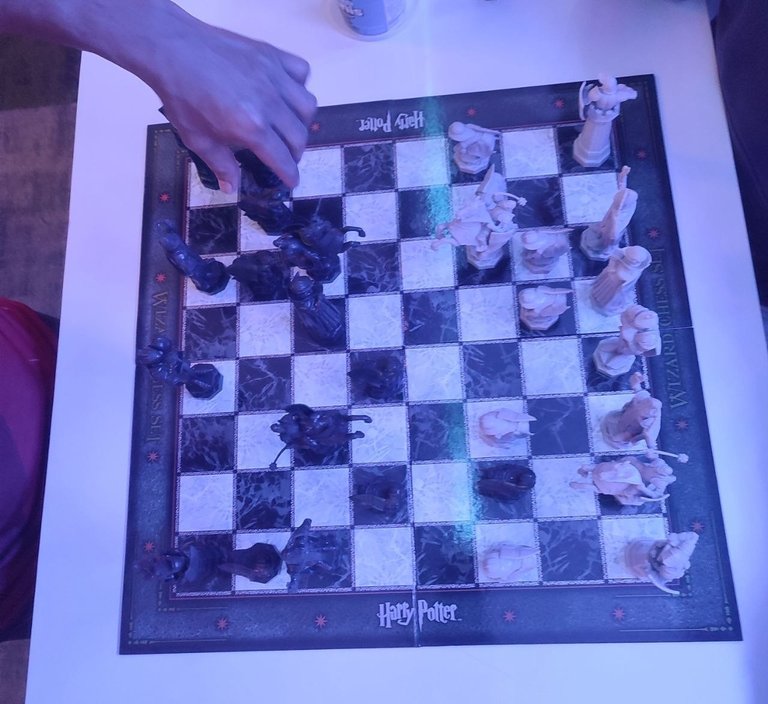
Imagen de la iniciativa, cortesía de @lanzjoseg.

Harry Potter
Esa escena escala en tensión hasta el clímax de La Piedra Filosofal, donde el juego deja de ser un pasatiempo para convertirse en una prueba de vida o muerte. Harry, Ron y Hermione deben ocupar el lugar de las piezas en un tablero gigante. Ron Weasley, asumiendo su papel de caballero, entiende que en el ajedrez —como en la vida— a veces hay que entregarse para que el Rey (o la misión de Harry) pueda seguir adelante. Esa tensión entre el objeto inanimado que cobra vida y la mente que lo dirige es lo que hace que la imagen de este tablero sea tan poderosa para mi.
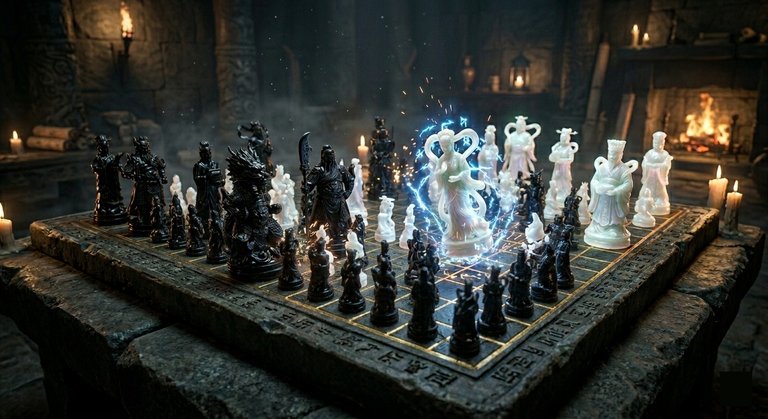
Gracias a la app Banana 2.0 por recrear esta imagen de Go Mágico para mi publicación.
Hoy, mientras observo a mi hijo Matthew explorar el milenario juego de Go (Weiqi), noto la diferencia de lenguajes. El Go es territorio, fluidez, equilibrio. El ajedrez, especialmente este de estilo "Potterhead", es épica y estructura. Sin embargo, hay un puente que podemos tender. Unir el mundo de la fantasía literaria con el rigor del escaque es una estrategia maestra para enamorar a las nuevas generaciones.
Si un niño ve en una torre el baluarte de un castillo encantado, o en un caballo el corcel de un héroe que se sacrifica por sus amigos, el ajedrez deja de ser un "ejercicio aburrido" para convertirse en una aventura narrativa. El tablero que nos muestra @lanzjoseg es la prueba de que el juego ciencia no ha envejecido, solo ha estado esperando el hechizo correcto para despertar de nuevo en las manos de los niños y jóvenes de hoy.
Bienvenidos todos a esta, mi participación de la semana en el TopFiveFamily. Si es de tu agrado participar, aún estás a tiempo. Este es el enlace Observa⇾Piensa⇉Escribe. Recuerda cumplir las reglas…

Portada de la iniciativa.
Dedicado a todos aquellos escribas que contribuyen, día a día, a hacer de nuestro planeta, un mundo mejor


There is a memory that lies not in the eyes, but in the fingertips, and today, with this week’s image provided by my friend @lanzjoseg, it has been reawakened in me. For those of us who learnt to decipher the world through touch, chess was never just a board game; it was a tactile battlefield. I remember the texture of that special board from my childhood; each square had a precise hole, a small abyss designed to receive the base of the piece. That perfect fit allowed my hand to hover over the battlefield like a protective shadow, recognising the rooks and knights without fear of upsetting the game’s outcome.
Where Magic and Chess Meet
This week, our friend @lanzjoseg, in his usual weekly competition, treats us to an image that is, in itself, a portal. Looking at that Wizard Chess board, inspired by Harry Potter, it’s impossible not to feel a shiver of nostalgia. The image shows us pieces with a heavy, gothic aesthetic, almost lifelike, which immediately transport me to the stone corridors of Hogwarts.
For a fan of J.K. Rowling’s series like myself, this board evokes a pivotal scene in the Great Hall. Harry and Ron are engrossed in a game where the pieces are not moved by the hand of a human player, but by the dictates of a magical will. It is there that Hermione Granger, with her usual pragmatism, watches in horror as a knight is reduced to rubble by the brutal blow of a bishop. “It’s a barbaric game,” she declares. But for us chess players, it is not barbarism; it is the physical representation of the loss and sacrifice demanded by strategy.
Image of the initiative, courtesy of @lanzjoseg.
Harry Potter
That scene builds in tension to the climax of The Philosopher’s Stone, where the game ceases to be a pastime and becomes a test of life or death. Harry, Ron and Hermione must take the place of the pieces on a giant chessboard. Ron Weasley, embracing his role as a knight, understands that in chess—as in life—sometimes you have to give yourself up so that the King (or Harry’s mission) can move forward. That tension between the inanimate object that comes to life and the mind that directs it is what makes the image of this board so powerful to me.
Thanks to the Banana 2.0 app for recreating this image of Go Magic for my post.
Today, as I watch my son Matthew explore the ancient game of (Weiqi), I notice the difference in their languages. Go is about territory, fluidity and balance. Chess, especially this ‘Potterhead’-style version, is about epic scale and structure. However, there is a bridge we can build. Bringing together the world of literary fantasy with the rigour of chess is a masterstroke for winning over new generations.
If a child sees a rook as the bastion of an enchanted castle, or a knight as the steed of a hero who sacrifices himself for his friends, chess ceases to be a ‘boring exercise’ and becomes a narrative adventure. The board shown to us by @lanzjoseg is proof that the game of chess has not grown old; it has simply been waiting for the right spell to awaken once more in the hands of today’s children and young people.
Welcome everyone to my entry for this week's TopFiveFamily. If you'd like to participate, there's still time. Here's the link: Observe⇾Think⇉Write. Remember to follow the rules…
Cover of the initiative.
Dedicated to all those writers who contribute, day after day, to making our planet a better world.